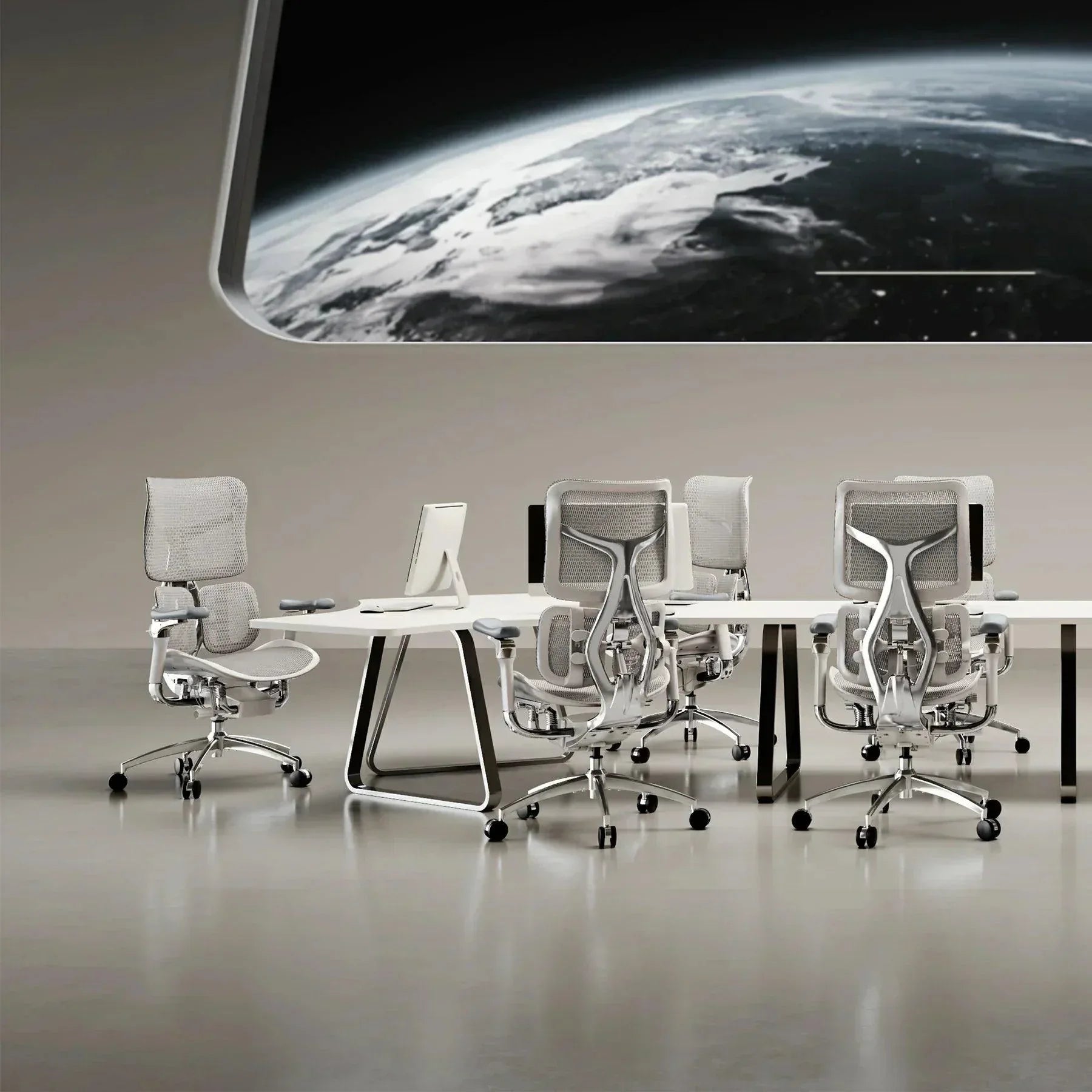
Those suffering from scoliosis know the problem: even after a short time sitting, tension, pressure sensations, or one-sided back pain begin. The reason lies in the asymmetrical load on the spine. While in healthy individuals body weight is distributed evenly, the lateral curvature leads to muscles, intervertebral discs, and joints being subjected to uneven stress.
This strain is particularly pronounced when working at a desk – for hours in almost the same posture. The goal, therefore, is not to "sit up straight," but to create a seating environment that allows movement, provides relief, and adapts to individual needs.
What is scoliosis?
Scoliosis is a lateral curvature of the spine, often involving a rotation of the individual vertebrae. It can be congenital, growth-related, or caused by poor posture and muscular imbalances.
Typically, the spine curves into an S or C shape, placing more strain on one side of the body. This asymmetry affects posture: shoulders, pelvis, and spine are no longer in balance.
When sitting, this means the body unconsciously shifts position – one side bears more weight, the muscles work unevenly, and over time pressure points or pain develop. This is precisely where an ergonomic, adjustable office chair comes in: it helps to distribute the load more evenly and allows for movement.

Why standard office chairs are not enough
Many manufacturers advertise with the buzzword "ergonomic," but not every ergonomic chair is automatically suitable for scoliosis. Some typical misconceptions:
- Symmetrical backrest shape: It follows the ideal shape of a straight spine, not the reality of an asymmetrical one. Result: One side is overstretched, the other compressed.
- Rigid lumbar support: A firm lumbar bulge can create pressure exactly where relief is needed when there is lateral deformation.
- A seat surface that is too hard leads to localized pressure on the pelvis – particularly problematic in cases of pelvic torsion, which is often associated with scoliosis.
Ergonomic doesn't mean "equally good for everyone." A chair must adapt to your spine – not the other way around.

What you should consider when buying a chair if you have scoliosis
The ideal solution is not a special chair for the sick, but a highly adjustable chair that supports dynamic sitting . The following features are crucial:
| feature | Why it's important |
|---|---|
| Backrest with independent zones | Supports asymmetrical posture, relieves the more curved side |
| Dynamic lumbar support | Automatically adapts to movements, prevents pressure on one side |
| Flexible seat surface with slight incline | Promotes micro-movements of the pelvis and improves blood circulation. |
| Multi-dimensionally adjustable armrests (4D/6D) | Relieve shoulders and correct pelvic tilt |
| High-quality, elastic mesh material | Regulates pressure and heat, avoids rigid sitting postures |
More important than the design is the micro-movement – the chair's ability to detect and support small body movements. A good chair keeps you moving without you even realizing it.
Practical example: Sihoo C300 vs Sihoo S300
These two chairs are excellent examples to understand the difference between "ergonomics" and "adaptability".
Sihoo C300 – Dynamic ergonomics for everyday life
- Self-adjusting lumbar support that moves with you.
- 4D armrests for variable shoulder relief
- Permeable mesh material and "waterfall" seat edge for pressure reduction
Who it's suitable for: Ideal for mild to moderate scoliosis or people looking for a responsive but affordable model.
The C300 offers good basic ergonomics as long as the curvature is not severely asymmetrical. The automatic adjustment can compensate well for slight misalignments.

Sihoo C300 Ergonomic Office Chair
The Doro C300 combines a 135° backrest, dynamic lumbar support, 4D armrests and breathable premium mesh with a weight-sensitive mechanism for optimal seating comfort – optionally with an integrated footrest for perfect relaxation in the home office or office.
Sihoo S300 – Premium mechanics with double support
- Dual, separately adjustable lumbar supports for individual pressure distribution
- “Anti-gravity” mechanism: when leaning back, the pressure on the lumbar region remains constant.
- 6D armrests, high-quality materials, quiet tilting motion
Suitable for: Users with more pronounced scoliosis or sensitive backs who desire maximum adjustability.
The S300 offers significantly more nuanced support, but can appear overly complex if incorrectly adjusted. Those who want to avoid the extra effort are often better off with the C300.

Sihoo Doro S300 Ergonomic Office Chair
Ergonomic premium chair with innovative anti-gravity mechanism, 6D armrests, double dynamic lumbar support and soft headrest for floating seating comfort – awarded the German Design Award 2023, 5-year guarantee, load capacity up to 136 kg.
What do physiotherapists say?
According to many physiotherapists, the goal in treating scoliosis is not to correct the spine, but to relieve pressure on and improve mobility of the back.
The German Association for Physiotherapy (DVG) clearly emphasizes this approach:
"In the case of scoliosis, the crucial factor is not the correction, but rather the relief and mobility of the back."
Maintaining a consistently rigid or forced upright posture is counterproductive for those affected. The spine needs freedom of movement to stabilize itself. Dynamic sitting – that is, small, constant movements of the pelvis and spine – promotes blood circulation, relieves pressure on the intervertebral discs, and reduces muscle tension.
Physiotherapists and ergonomics experts therefore recommend chairs that
- allow multidimensional movements,
- react automatically to body shifts,
- and do not create a fixed pressure point in the lumbar region.
This allows the body to remain active without the user having to consciously do anything. A good office chair supports the natural function of the back instead of forcing it into an artificial posture.
Reducing strain is more realistic – and more effective in the long run – than striving for a "perfectly straight" spine. Therefore, anyone who works or studies with scoliosis should opt for a seating system that combines movement, adjustment, and support.
Before you buy: What you should really pay attention to
- A test sit is essential. Feel whether the chair supports your back evenly.
- Pay attention to the settings options. The more freedom there is, the better the support can be customized.
- Avoid extreme values. Backrests that are too soft or too rigid can increase pressure points.
- Long-term testing instead of immediate judgment. Assess the seating comfort after at least 30 minutes, not after 3.
My advice as an ergonomics consultant: Use your body as a benchmark – not marketing. A good chair fades into the background of everyday life because you don't need to be constantly aware of it.
Conclusion
A scoliosis office chair is not a special product, but a tool for intelligent relief. Whether it's the Sihoo C300 or the S300 – the crucial thing is that the chair allows movement instead of forcing you into a "perfect" posture.
FAQs
Can I sit on a normal chair if I have scoliosis?
Yes, but only briefly. What's crucial is dynamic support throughout the workday.
Is the S300 worth the extra cost?
For users with significant asymmetry or very long sitting times: yes. Otherwise, the C300 is often sufficient.
Does stool help with pain?
It can reduce stress, but it does not replace medical treatment.